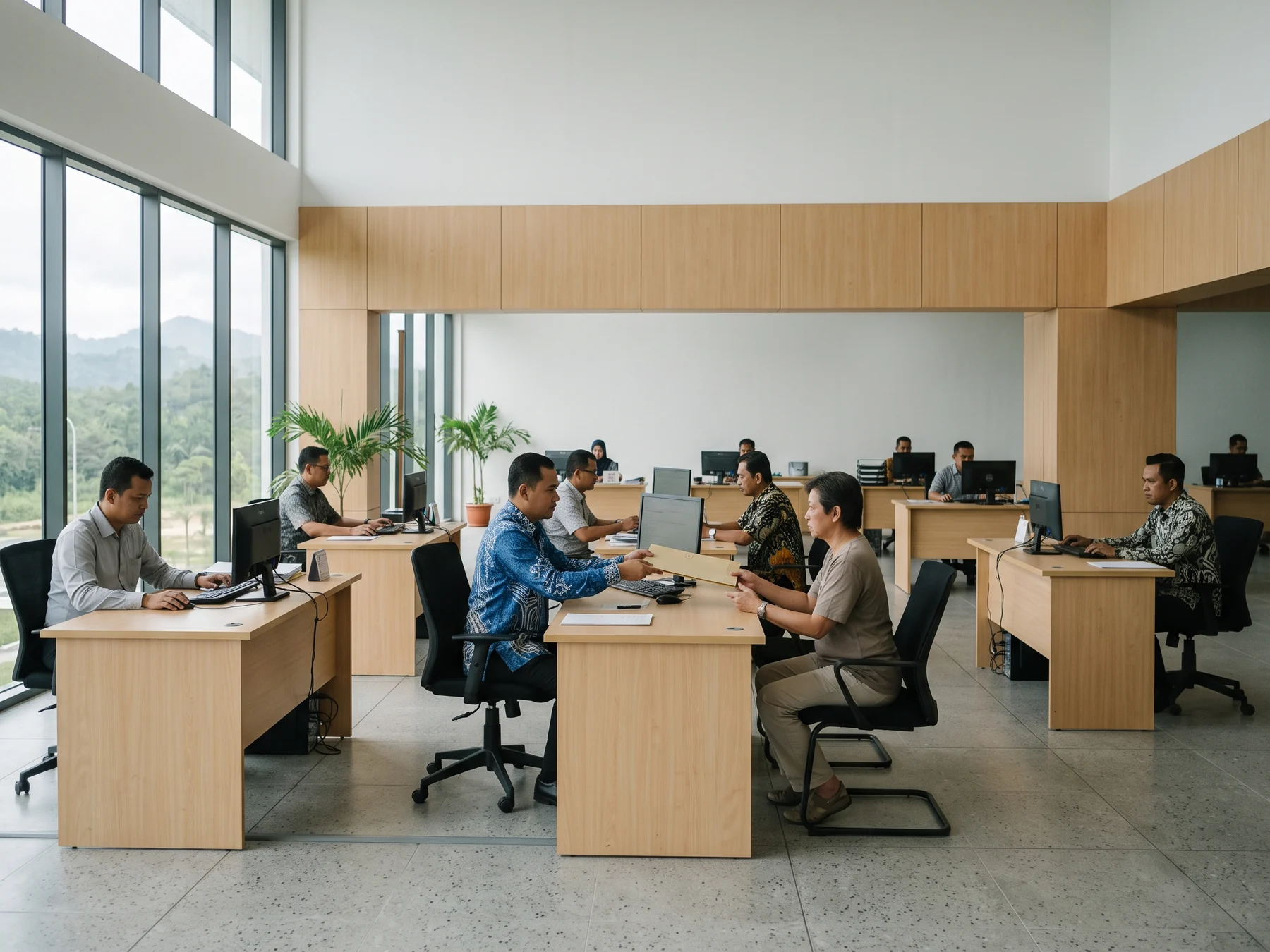
Three layers of approval, one sequence.
Almost every complaint about Malaysian licensing comes from treating it as one queue. It is three, and they run partly in parallel. Below: the full path from incorporation to opening day, then what sits with Putrajaya, what sits with Sabah, and what your sector adds on top.
HOW LICENSING WORKS
Nothing in layer two can start before layer one is done. Layer three usually runs alongside layer two rather than after it.
SSM incorporation, tax file, EPF and SOCSO. Nothing else can start until this is done.
Trade and signboard licences from DBKK or your municipal or district council, with fire, health and planning clearances behind them.
MIDA, MITI, MOTAC, CIDB, MOH and their Sabah counterparts license what you actually do inside the premises.
WHO GOVERNS WHAT
Sabah holds powers no other Malaysian state does, land, labour and immigration among them. That is why some approvals are filed twice, once in Putrajaya and once in Kota Kinabalu.
Registration of the legal entity, national taxation, and licensing of activities regulated across Malaysia.
Approvals that exist federally but require a Sabah counterpart before you can operate on the ground.
Sabah retains autonomy over land, labour and immigration. The premises itself is always licensed here.
Shared approvals are not duplicates of each other, the federal instrument establishes the right to operate nationally, the Sabah instrument is what lets you work on the ground here. Budget for both.
WHAT’S DIFFERENT IN SABAH · THE TRADING LICENCE
Business licensing here runs on a state ordinance older than the Federation itself, the Ordinan Lesen Perniagaan 1948, the Trades Licensing Ordinance.
The Ordinance is the parent law behind every trading licence in the state. Inside a city, municipal or district council area it is administered by that local authority together with the Local Government Ordinance 1961 and the Uniform Licensing By-laws 2022. Everywhere else, the District Officer issues it directly.
Federal registration with SSM proves your company exists. It does not, on its own, entitle you to trade anywhere in Sabah.
Shops, offices, hawkers, itinerant traders, contractors working on site and companies incorporated outside Sabah. The licence attaches to the premises and the trade described in it.
Changing address, trade description, ownership or floor area requires the licensing authority’s approval. Operating outside the terms stated on the licence voids it.
Unlicensed trading is an offence under the Ordinance. Authorities may compound the offence, order the premises closed, or prosecute, and a lapsed renewal counts as unlicensed.
LAYER THREE · SECTORAL LICENCES
Filter by what you intend to do. Each entry shows the instrument, who issues it, and whether it sits federally, with Sabah, or both.
| LICENCE | WHO NEEDS IT | ISSUER | LEVEL |
|---|---|---|---|
| Manufacturing Licence | Manufacturers with shareholders funds of RM2.5 million or more, or 75 or more full-time employees. Smaller operations apply for an exemption letter. | MIDA | FEDERAL |
| Licensed Manufacturing Warehouse | Exporters importing raw materials and components duty-free for re-export. | JKDM | FEDERAL |
| Wholesale, Retail & Trade (WRT) | Trading, retail and wholesale businesses more than 50% foreign-owned. Requires RM1 million paid-up capital. | MITI | FEDERAL |
| Halal Certification | Food, beverage, cosmetics and pharmaceutical producers selling into Malaysian and export halal markets. Optional but commercially significant. | JAKIM | FEDERAL |
| Tourism Licence | Hotels, travel agencies, tour operators and car rental services. In Sabah, register with the Sabah Tourism Board as well. | MOTAC + STB | SHARED |
| Tourist Guide Licence | Individual guides operating in Sabah, including nature and island guides. | MOTAC + State | SHARED |
| Contractor Registration | Construction, engineering and building-related services. Sabah projects additionally require PUKONSA registration. | CIDB + PUKONSA | SHARED |
| Environmental Approval / EIA | Projects listed under the prescribed activities order, plantations, quarries, heavy industry, coastal development. | DOE + State | SHARED |
| Food Premises Licence | Restaurants, cafés, caterers and hawkers, with food handler certification for all staff. | Council + MOH | SHARED |
| Medical & Healthcare Facility | Clinics, hospitals, wellness centres and traditional medicine practitioners. | MOH | FEDERAL |
| Education Institution Approval | International schools, kindergartens, colleges and training centres. | MOE | FEDERAL |
| Financial Services & Fintech | Lending, digital payments, financial advisory and investment products. | BNM / SC | FEDERAL |
| Freight Forwarding & Customs Agent | Logistics operators clearing goods through Sabah ports and airports. | JKDM | FEDERAL |
| Agricultural & Plantation Permits | Oil palm, aquaculture and timber operations, including state land use and produce movement permits. | State agencies | STATE |
| Sabah Work Pass Endorsement | Any company employing foreign nationals in Sabah, in addition to the federal Employment Pass. | Sabah Immigration | STATE |
Not sure which apply to you? Tell us your sector and where you intend to operate, and our officers will confirm the exact list before you file anything.
THE TRADE LICENCE ITSELF
Zooming in on the council stage of the track above: whatever your sector, the application itself always runs through the same six steps.
- 01Identify licence type
Determine whether your business requires a general trade licence, a food & beverage licence, a professional service licence or an industrial licence.
STEP 1 OF 6 - 02Prepare required documents
Gather the SSM incorporation certificate, IC or passport copies of directors, tenancy agreement or proof of premises, floor plan, and any sector-specific approvals.
STEP 2 OF 6 - 03Submit to the local authority
File at Kota Kinabalu City Hall (DBKK) or the relevant municipal council, either over the counter or through the Sabah Digital Portal.
STEP 3 OF 6 - 04Pay licence fees
Fees vary by business type and size, typically RM50 to RM1,000 a year. Certain industries also carry a deposit.
STEP 4 OF 6 - 05Inspection and approval
The council may inspect the premises for fire safety, sanitation and compliance before the licence is issued.
STEP 5 OF 6 - 06Receive and display
Once approved, the licence must be displayed prominently at the premises and renewed annually.
STEP 6 OF 6
POINT OF APPLICATION
Which counter you file at is decided by your address, not your sector.
For businesses operating within the Kota Kinabalu city boundary.
Sandakan, Tawau, Lahad Datu and other municipal areas.
For premises in rural districts outside municipal boundaries.
Online submission is only available for selected councils.
NEXT STEPS

Tell us what you’re planning.
GET IN TOUCH